
In the summer of 2025, the Vermont Legislature approved Act 73, also known as the Education Transformation Law. Act 73 will establish larger school districts than Vermont currently has now–encompassing up to 8,000 students per district–instead of the maximum of 4,000 that many of these school districts currently serve.
Mega-districts have become the new norm for urban areas, in an effort to incorporate the dense population of students in a concentrated area. These districts are defined as public school districts serving an exceptionally large student population requiring complex, large-scale administrative and educational systems. For reference, the New York City School District or the Los Angeles Unified School District are some of the largest in the nation.
To enforce Act 73 in Vermont, a Redistricting Task Force has been created to develop a map to draw lines for the future districts. The Task Force includes three Vermont House Representatives, three Vermont Senators, and five non-legislative members.
A proposed district map curated in September by the Vermont School Redistricting Task Force developed new concerns within the direct Essex Westford community and neighboring towns. The map included all ten districts of Chittenden County schools, forming a mega district of roughly 22,500 students, followed by the next biggest district with just over 7,000 students.
In response to circulating concerns among the community, the Essex Westford School Board released a public statement against Act 73, claiming the proposed map was “offensive.” Essex Westford School Board has been one of the few school boards in Chittenden County to publicly address Act 73.

“The EWSD School Board chose to publish an official statement on the harms from Act 73 to ensure that those implementing these changes at the state level fully understand the scope and potential harm of this legislation on Vermont’s public education system,” Robert Carpenter, Chair of the EWSD School Board, said.
The EWSD School Board further pointed out that Chittenden County holds the most diverse student population, and suppressing these voices of the minorities would be inequitable.
“This shift threatens the community-centered advocacy and equity-focused work that smaller or more diverse districts like ours rely on to meet students’ needs,” Carpenter said.
Senators and State Representatives on the Redistricting Task Force have actively attempted to take into consideration these opposing opinions while also carrying out the redistricting legislation as it was passed.
“We ended up hearing from over 5,000 people,” said Senator Martine Gulick, Co-Chair of the Vermont Redistricting Task Force. “Off the top of my head, I honestly can’t think of anybody who spoke to us who was in favor of what we were doing.”
Senator Gulick further explained that the Task Force was given three months, from August to November, to curate a map taking into account various factors, ranging from grand list value (a measure of community wealth) to facility conditions.
“If you are a student or a family in a 21,000 student district, how much access are you going to have to leadership and to administration?” said Gulick. “And how much is your voice going to be heard?”
Other notable factors that needed to be considered included transportation logistics, historic community connections, student demographics, population distribution, staffing levels, salary scales, and maintaining community voices and representation.
On November 20th, at the final meeting of the Redistricting Task Force, the representatives decided not to proceed with the September proposed map or a new map at all. Instead, they proposed education cooperatives, strategic and voluntary mergers, along with regional high schools to improve efficiency and reduce costs.
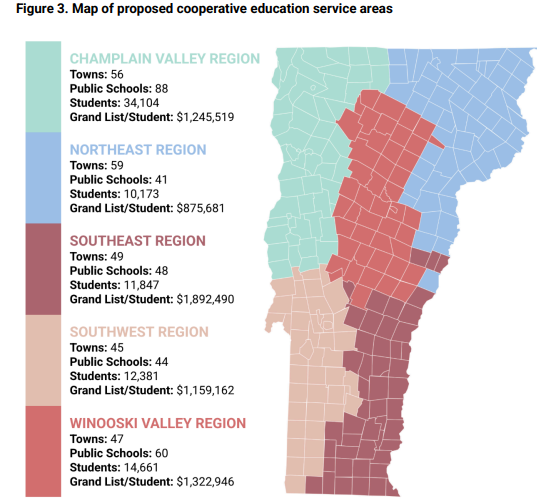
“Our proposal does not draw new lines,” Senator Gulick said. “It does not force any mergers. There was no solid data suggesting that forced mergers save money and improve quality.”
The Task Force’s final approach has generated disruption within the state government. Though many communities are satisfied with the outcome, prominent supporters of the Education Transformation Law, such as Governor Phil Scott, are displeased.
“The governor’s calling us a failure because we didn’t actually want a map,” Senator Gulick said. “But I think [we’re] putting forward a really good plan.”
Lori Houghton, Vermont House Representative for Chittenden-22–which includes the Essex High School campus–shared that she believed that, although no map was drawn, the Redistricting Task Force was still successful.

Additionally, Representative Houghton shared that redistricting issues along with other education issues don’t follow traditional party lines. Instead, “it’s a very local issue that is going to be impacted by what local school districts and communities need. That is why this is so difficult.”
The final proposed plan does however, mention regional high schools as a possibility. Currently, high schools within Vermont offer a variety of options, including Technology Center programs, but there is not an established uniformity.
“We know we have a system that is not equitable. EWSD kids have so many opportunities that other districts don’t,” Representative Houghton said. “We need a state education system that ensures all kids have what they need to be successful.”